One of the mantras of the Online Community Unconference became "keeping the party rolling" - not because we partied all day in night, but because many attendees were already in the community business, but looking for ways to improve the experience and value on an ongoing basis. Indeed, the group was a mix of the very experienced and those just getting started.
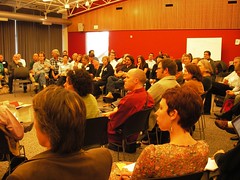
Speaking of a mix of people, my guess is that that there were about the same number of women as men at the conference and as tech conferences go, that is something different and special.
The session I led was called "New Community Planning" with an appended title of "Getting the Party Started." I was happy to see the party metaphor put to this use and introduced the session with some of my thoughts from my previous post "Your Community is a Party Waiting to Happen." The party metaphor worked well in this case and, as it turned out, I did little talking during the session (a good thing!).
We started off discussing some of the elements that go into getting started with community and I started writing things on a whiteboard. Here are my mostly mental notes, based on what I wrote on the board...
- Look at the communities that exist offline and consider interviewing them or doing a focus group
- Understand the #1 priority of the community - why does it exist?
- Have a strong understanding of the audience
- Define the user - where are they now? What do they need?
- Make sure to have a host or "social director"
- Create an outreach strategy - how will your audience know about the community?
- Ensure that the initial experience is compelling - give people something at the very beginning (people, content, event, etc.)
- Think about the initial discussions that will occur and make sure they are pertinent to the desired audience
- Define what success looks like - is it addressing a need?
- Question - does the organization have a definition that's different?
- Set expectations around the ebb and flow of participation - it will come and go - try to see trends
- Create clear and useful guidelines
- Start small - don't create a large number of forums until the community needs them.
- When thinking of features and tools, relate them to specific purposes - no features for features sake.
- Make it easy and obvious that members should invite their friends
- Show energy - display the flow of member participation - show the community is alive
- Give the members easy ways to learn about and connect with one another
- Understand diversity in terms of new members and veterans - try to find a matching or mentoring system
- Give new members a safe place to ask questions, etc.
- Maintain community life - once members start to feel it, keep looking for ways to promote community
- Have rituals - events or practices that the community can participate in on an ongoing basis - something that is specific to the community
- Enable people to become "gardeners" - people who take care of the community
- Give hosts the ability to mentor other hosts - learn about hosting practices.
- Make hosting a privilege, not a right - consider asking hosts to re-apply after 6 months
- Share the vision of the community with members - enable them to "buy" into the goal of the community
- Balance vision with control - don't let control issues get out of hand
- Be transparent as the hosts and/or the organization - show who you are
All in all, I thought the session turned out well and the attendees had great questions and insights. I owe thanks to Scott Moore , Gail Ann Williams and Jake McKee who contributed a wealth of knowledge and experience.
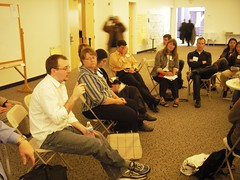
As for the conference, I was very impressed. The Open Space Technology worked perfectly for the group. All the sessions I attended were lively and informative - people were not bashful about getting involved. Kaliya Hamlin ran the show and Bill Johnston rocked as the MC and organizer.
I was also impressed with the experience of the group, from the originators of online communities like Howard Rheingold , Cliff Figallo and John "Tex" Coate to community managers from eBay, Yahoo, Amazon, Cisco, Microsoft, etc. There was just not enough time to take it all in.