
Discovering the RSS Explanation Problem
By leelefever on January 23, 2008 - 11:29am.
I remember the exact moment when it first became apparent to me that there was such a thing as an explanation problem. I was at a small conference on Silicon Valley in early 2004. There was a CEO of a start up there and during his talk, he mentioned RSS. Someone raised their hand and asked the question "What is RSS?"

This CEO's responses to the question, and I'm not kidding, was "RSS is an XML-based content syndication format." As you might expect, this was met with a look of bewilderment.
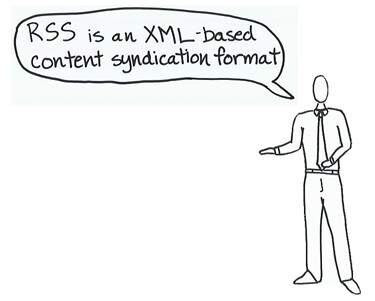
I was in the audience and had an AHA! moment. It was clear to me that RSS had an explanation problem that was preventing it from being adopted. Every time someone went looking for information about RSS and found that it was "an XML-based content syndication format" an opportunity was lost.
Since then I've been thinking a lot about explanation problems I'm starting to define them and the problems they cause. Ultimately, I think it's about adoption - adoption of an idea, a product or service. Good explanations increase adoption and poor explanations limit adoption. Here's how I'd explain it in Plain English.
An explanation problem exists when there is a mismatch between what is heard and what matters to the target audience.
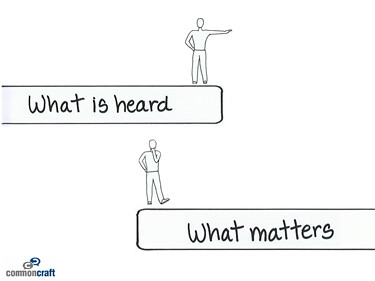
Looking back at the RSS example, the question was asked by someone curious about RSS and the answer, while correct, didn't matter to the asker. The CEOs explanation didn't help them to see why they should care.
An interesting way to look at this situation is by considering how questions are asked. Often, when someone asks "what is...", they really mean "Why does it matter to me?" By considering what matters to someone, the answer becomes different and more likely to give them information they can act on.
One of the things that we've learned is that explanation sometimes means answering a different question than was asked. It's not always "what is it?" as much as "why should I care about it?"
Of course, the example with the CEO is what led me to write this blog entry (a month after the conference) and eventually, this video with Sachi.
Lee, I gave a presentation
Lee,
I gave a presentation to a group of college level instructors about the use of technology in education. When I talked about RSS, blogs, wikis, etc. their eyes glazed over. I used a wiki for the presentation and later added your videos on RSS and wikis to it. You explain these concepts way better than I did in that presentation. I learned a lot.
http://mctoonish.wikispaces.com/Summer+Institute+Presentation
Thanks for letting me know
Thanks for letting me know Heather! Happy to have helped.
Thanks for shedding the light so well!
I work in a government-owned organisation with a mandate to support educators in the use of technology to improve their teaching.
Your videos are shining examples of putting the end user first by clearly demonstrating benefits rather than trying to break down features.
If someone asks how to turn on the lights in a room, they don't need a simplified (or complicated) explanation of the lighting grid in the building and the room, followed by an explanation and comparison of different light bulbs and currency systems. They just need to know where the light switches are and how to operate them!
Plain English Save
I'd triedto explaining RSS and Wikis to family members, friends, and people at my company for a long time but no matter how I explained it they never saw the potential. It wasn't until I used your RSS and Wiki videos did they "get it". That was also when I really learned exactly what you put to words - What it is doesn't equal why it is useful.
After they watched the video and I provided details about how it will be useful as opposed to how it works - the lightbulb lit up. Even used a wiki for Xmas coordination and the entire family was happy with it.
The same situation is actually occurring right now with the Pownce service (pownce.com). When friends go to the site it only explains what it does - not what benefits it provides to a user. This has made it hard to entice friends over to this new service. They could really take a page out of your book - or maybe just hire you.
Thanks for these videos.
I love your videos and use
I love your videos and use them with classes and with friends. You give the "big picture" that motivates them so that they will learn how to use wikis, social bookmarking etc.
Thanks.
Show don't tell
I love being shown things. I hate having them explained to me.
Some people literally insist on explaining before they'll show.
People do this all the time to children. It must drive kids crazy.
Show me first then ask me if I want an explanation.
When You Have a Hammer, Everything Looks Like a Nail
I stumbled upon your web site tonight and am so engaged, it will be hard to settle down to sleep. Like the others mentioned, kudos to you for these Plain English videos.
In addition to the explanation problem, I find lots of Web 2.0 evangelists pushing tools without understanding the user's underlying need. What matters to users, is technology that is a tool to solve a problem they have.
Technology can also solve problems people don't know they have -- or have been living with, not aware there is a tool that would enable them to approach the problem differently. But, I think the adoption rate for this type of user to use a new technology is lower. E.g. I love the simplicity your camping example in the Wiki video. In reality, would newly-aware-of-wiki users convert to a wiki to improve their communcation?
Unknown Problems
Thanks Rose and others for the kind words. I think you make a good point when you say:
"Technology can also solve problems people don't know they have -- or have been living with, not aware there is a tool that would enable them to approach the problem differently."
It's so true. I think a good example that a lot of products are focusing on is email attachments. We've sent attachments for so long, it doesn't occur to us that they create problems - it's just how email works. To get over this, I think better explanations can help turn light bulbs on.
About the wiki example, I think awareness is only part of the battle. Wikis are not for everyone and never will be, but hopefully awareness leads to adoption for some.
email attachments
Lee, if there is some wonderful way to handle email attachments you know about, I'd appreciate your sharing it.
Perhaps you are thinking of using a wiki with RSS feeds for collaboration instead of email, a concept I endorse wholeheartedly.
It's my dream to visit
It's my dream to visit Silicon Valley!
You nail it
Lee, you just nail it! And it's not only about RSS, but tech concepts in general.
I wrote a little though on the matter here after reading your post.
It's a tough quest you guys are doing but I have to admit the answer to this problem is one of the most difficult to attain and you did it. Well done and keep the good work!
Maybe you'd like to do a series for math?
Factoring in Plain English
Derivative Notation in Plain English
Integration Techniques in Plain English
Partial Fraction Expansions in Plain English...
hmm ... the list goes on and on.
Seriously, though... great videos - I use them in a lot of my technology trainings and they make the use of the technology crystal clear.
New word for RSS?
I fully agree! RSS is like a secret word and sounds too technical. Last week I wondered if more people would be into RSS if the name had been different/less technical.
On the other hand, it makes people feel cool when they DO understand...
... and it relates to adoption of sustainable behaviours
Lee
I really like this example. I run community behaviour change programs that seek to enable the adoption of sustainable behaviours (eg. cfl lightglobes, insulate roof, NOT use the air cond so much!).
Everything in our workshops and project need to relate to what matters most to each individual (or each community). Answering participant questions with an answer is often not enough ... it needs to be followed with something that relates to their own lives.
Cheers
Geoff
Creating Custom RSS Feed
Hi! I'm a librarian and stumbled upon your post. If you are into RSS feeds, then one tool I'd highly recommend is Feedity ( http://www.feedity.com ) that let's you create custom RSS feeds from all those websites and webpages which do not yet have a RSS feed. Its really smart and fast too! Chao :)
"RSS" ?
Yes, but what do the letters "R-S-S" stand for? Presumably an acronym?
Post new comment